Renaissance Videos About Art Renaissance Italy Videos About Art
Donatello (1386 – 1466) was Italian artist who was the leading sculptor of the early Renaissance. He gave a different direction to Western art taking information technology away from the prevalent Gothic style, which was marked by softly curved lines and an expressionless face up, to the Classical style with dramatic expressions and detailed realism. Donatello pioneered several artistic techniques, similar schiacciato (flattened out). His techniques and works would have a profound and immense influence on subsequently generations of Renaissance artists. Know almost the art of Donatello by studying this 10 most famous works including David, Zuccone, Saint Mark and Penitent Magdalene.
#x The Feast of Herod
Blazon: Bronze Relief
Year: 1423 – 1427
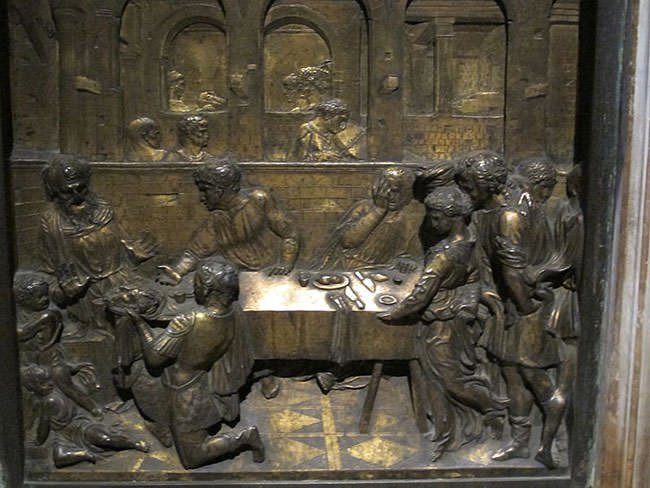
The Feast of Herod is i of Donatello'south earliest relief sculptures and his start statuary relief. It depicts an executioner presenting the severed head of John the Baptist subsequently Salome asked king Herod Antipas for John'south head on a platter. Filippo Brunelleschi was the leading architect of his era and a friend of Donatello. He had adult a technique for linear perspective. Taking inspiration from Brunelleschi's technique, Donatello first showcased his command of scientific linear perspective in this famous relief. The inclusion of linear perspective would later go a standard element in Renaissance painting and sculpture.
#9 Saint Mark
Type: Marble Statue
Year: 1411 – 1413
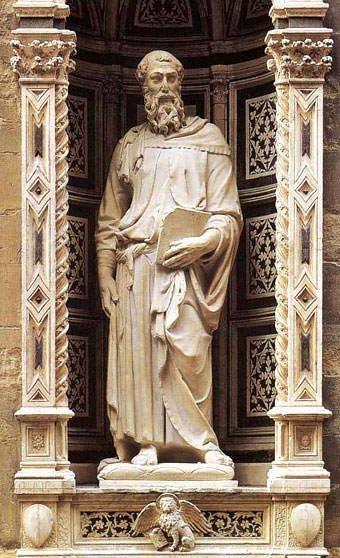
Donatello's initial works like the Marble David were carried out in the Gothic style, which was the prevalent style for sculpture at the fourth dimension. It was in his marble statues of St. Mark and St. George that he outset completely moved away from the Gothic style towards classical techniques. For the showtime time since Classical artifact the human personality was shown with such conviction in its ain worth and the expressions were so dramatic and emotional. Donatello's St. Marking is as well known for its natural pose, detailed realism and a much more naturalistic way than prevalent in the age.
#8 Works for St. Anthony of Padua
Year: 1447 – 1450
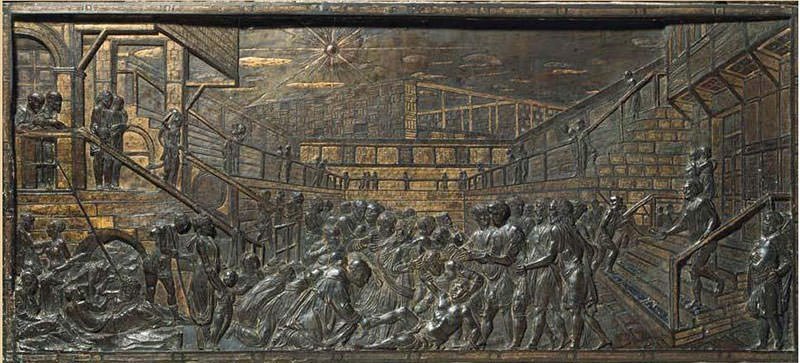
Sometime effectually 1450, Donatello undertook a massive project for the church Saint Anthony of Padua. His piece of work contained seven life-size statuary statues, 21 bronze reliefs of various sizes, and a large limestone relief. Unfortunately today nosotros can have no idea of the true architectural arrangement of all this material as it was taken down a century later and the reconstruction of 1895 is incorrect both aesthetically and historically. Renowned amidst the piece of work Donatello did for the Paduan Church is a splendidly expressive statuary crucifix and 4 extremely important reliefs with scenes from the life of St. Anthony for the high altar.
#7 Judith and Holofernes
Type: Bronze Statue
Year: 1460
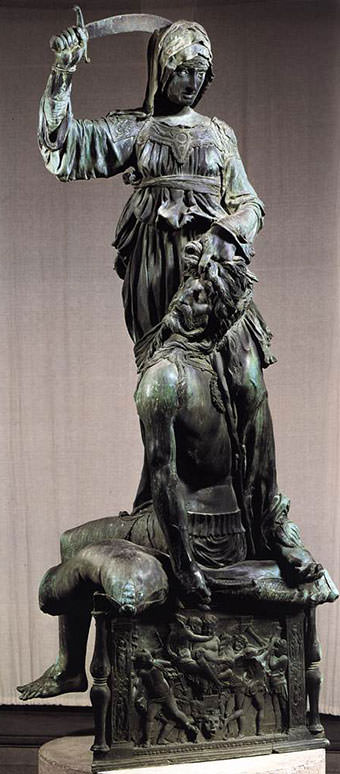
In the Book of Judith, Holofernes was the invading general of the powerful Nebuchadnezzar who had given him the job to destroy the nations of the w who wouldn't regard him equally the simply God. When Holofernes was nearly to accept over the biblical metropolis of Bethulia, it was saved by a beautiful Hebrew widow named Judith who seduced him and beheaded him while he was drunkard. This masterpiece depicts that assassination. It is remarkable for being amidst the earliest freestanding statuary Italian Renaissance statues and one of the first to be conceived in the round, with its four distinct faces.
#half dozen St. George Killing the Dragon
Type: Marble Relief
Year: 1416 – 1417
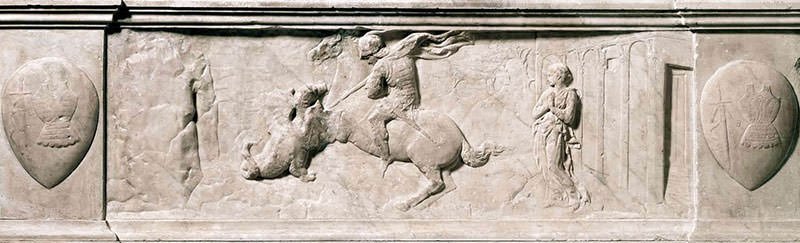
Relief is a sculptural technique where the sculpted elements remain attached to a solid background of the same fabric. Information technology had always been a trouble for sculptors because it must follow a narrow path between the two-dimensionality of painting and the three-dimensionality of full-round sculpture. Donatello introduced his bold new style of relief in this sculpture. The technique is known as schiacciato (flattened out) and in it the plane is only very slightly lower than the sculpted elements creating the illusion of depth and figures moving in space. Schiacciato strongly influenced later relief sculpture. St. George Killing the Dragon is likewise famous for beingness one of the first examples of central-point perspective in sculpture.
#five Zuccone
Type: Marble Statue
Yr: 1423 – 1425
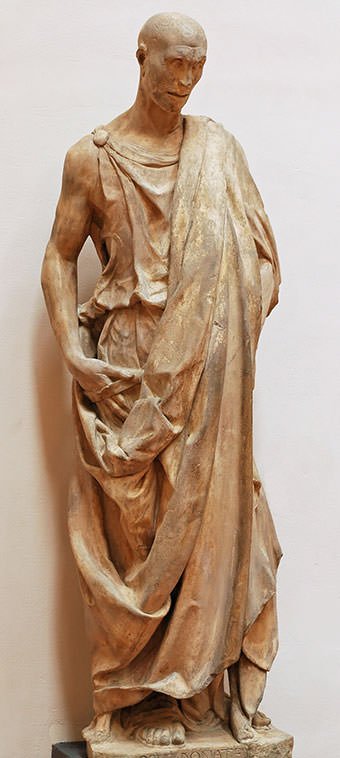
Between 1415 and 1426, Donatello created v statues for the campanile or bong tower of the Florence Cathedral in Italy. This work is most famous of the v campanile statues and considered one of the most important marble sculptures of the 15th century. Though it is non known with certainty, many believe that information technology depicts the Biblical figure Habakkuk which is why it is also known every bit the Statue of the Prophet Habakkuk. The pop proper name for the statue Zuccone means pumpkin and comes from the fact that the figure is bald. The statue is known for its realism and naturalism and it is said that it was Donatello's favorite and he used to swear by the sculpture, "By the religion I place in my Zuccone."
#four Saint George
Type: Marble Statue
Year: 1415 – 1417
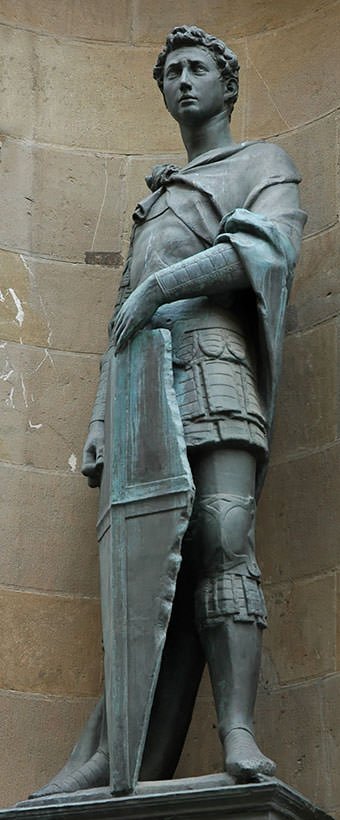
Along with his Saint Mark, this statue is considered his earliest work which displays his radical motion away from the prevalent Gothic style. St. George is considered by many art historians equally the slice which more than any other changed the management of the art of sculpture. In it Donatello showcases deep knowledge of the human being effigy at residue and brilliantly captures the tension betwixt repose and action. The awe-inspiring simplicity and power of the piece is achieved by subtle manipulation of the planes and technical brilliance in carving the marble. It is non but among Donatello's masterpieces but also had a profound and long lasting influence on Renaissance sculpture.
#3 Penitent Magdalene
Type: Wood Statue
Yr: 1453 – 1455
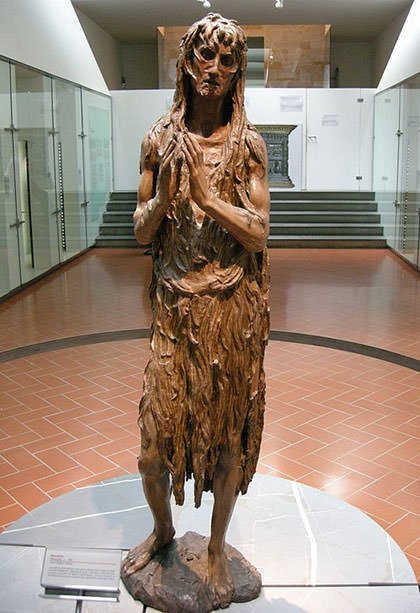
Donatello'due south abnormally weak and emaciated delineation of Mary Magdalene was in stark contrast to other depictions of her which commonly showed a beautiful immature woman in perfect health. Magdalene is said to have spent thirty years in the desert repenting for her sins which is what Donatello represents in this marvelous work. He thus ignored the Western legends by which Mary was daily fed by angels in the desert. Penitent Magdalene was received with awed admiration for its unprecedented realism and exquisite details. Information technology remains 1 of Donatello's near renowned works and is considered his greatest masterpiece in woods.
#2 Equestrian statue of Gattamelata
Blazon: Bronze Statue
Year: 1453
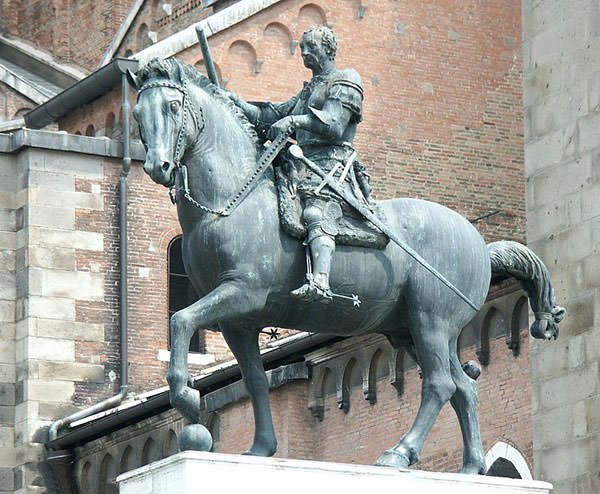
Erasmo of Narni, also known every bit Gattamelata (honeyed cat), was among the near famous condottieri or military leaders of Venice. Later on his death in 1443, his family unit granted Donatello the commission to create a statue of him. The result was vastly dissimilar from all equestrian statues made since antiquity. The facial expression of Gattamelata is dominant and determined; and he and his powerful horse are ready for activity. Such is the grandeur, authority and power which the statue exhibits and such was its fame at the fourth dimension that the Male monarch of Naples immediately wanted Donatello to practise a similar statue of him. Equestrian statue of Gattamelata was the first to reintroduce the grandeur of Classical equestrian portraiture and is considered the antecedent of all the equestrian monuments erected since.
#1 David
Type: Bronze Statue
Year: c. 1440s
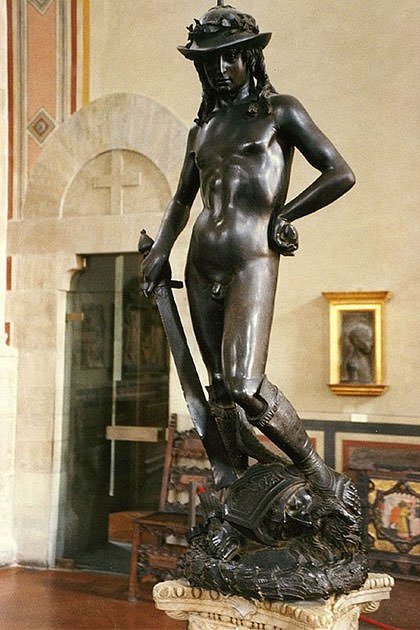
The Bronze David is renowned for being the commencement large-scale gratis-standing nude statue since antiquity. It depicts David, of the story of David and Goliath, property the sword of his defeated enemy and with his human foot on Goliath'due south severed caput. David is completely naked, apart from a laurel-topped hat and boots. The well-proportioned and fragile effigy of David bears contrast with the giant sword in his hand perchance indicating the assistance of God in his achieving the incredible feat. Donatello also produced a marble statue of David in Gothic style earlier merely it is nowhere equally famous as this work which is considered his most influential work and greatest masterpiece. Statuary David resides in the Museo Nazionale del Bargello in Florence.

Postar um comentário for "Renaissance Videos About Art Renaissance Italy Videos About Art"